What Sustainable Custom Cabinetry Really Means And How MYRA Studio Sources Wood, Selects Finishes, and Builds for Longevity
You've seen the copy. *Eco-friendly living. Mindful materials. A commitment to our planet.* Beautiful, weightless sentences that could be describing a bamboo cutting board or a private jet charter. If a paragraph about sustainability doesn't name a species, a supplier, a distance, or a dollar figure, it isn't telling you enough. It's just wearing green.
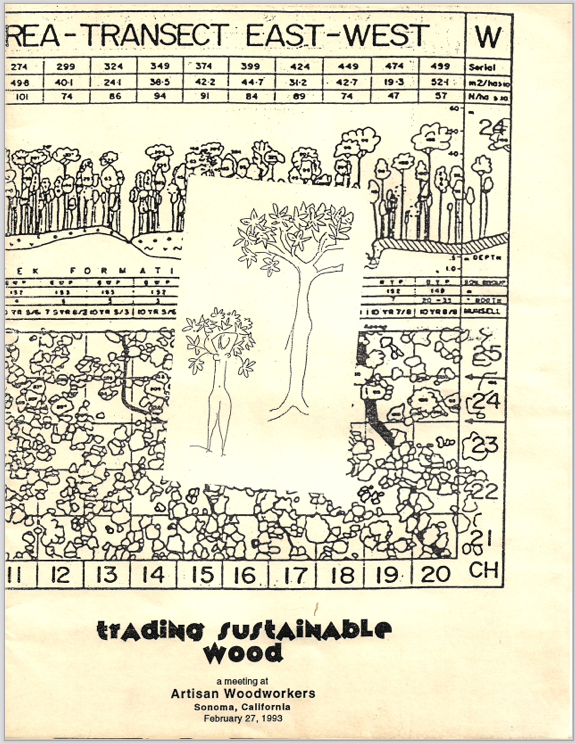
In February 1993 I attended a meeting called "Trading Sustainable Wood," hosted by my dear friend John Ward. I still have the brochure — I've scanned a few pages for you below, and yes, the design is very 1993.
The people in that room — the Tropical Forest Foundation, the Woodworkers Alliance for Rainforest Protection, the Institute for Sustainable Forestry, Sea Star Trading — were trying to do something that sounds obvious now and sounded insane then: get buyers to ask a second question about wood.
The first questions had always been, “What color is it, and what does it cost?” We wanted the second one to be “Where did it come from, and what happened to the forest it left behind?” That work turned into the Forest Stewardship Council, founded that same year.

Thirty-three years later, the FSC has genuinely changed how forests get managed worldwide. Knowing where your wood comes from is now a real purchasing criterion for the largest buyers of timber products — IKEA, Crate & Barrel, Williams Sonoma, Home Depot.
But our hope in 1993 that all wood in the marketplace would be certified by now has not been realized. By the end of 2025, FSC-certified forest had passed 171 million hectares, growing more than 6% in a single year. Real progress. It is also about 4% of the world's 4.14 billion hectares of forest, and the great majority of it sits in Europe and North America — temperate and boreal ground that was already among the best managed. We built the system to slow tropical deforestation, and that is largely not where it took root.
The other thing that happened is that certification followed fiber. Paper and packaging carry the FSC label at rates the solid wood and furniture trade doesn't approach. If you can find a certified notebook more easily than a certified dining table, now you know why.
The reason isn't mysterious. Like most sustainable products, certified wood carries costs that uncertified wood simply avoids. The timber company that clearcuts a hillside and walks away never pays for the depleted groundwater, the lost habitat, the changed weather, or the jobs that don't come back.
In a nutshell: we endorse FSC as the most reliable and ethical system we have for certifying forest products. In the complicated world of global timber, they are the good guys.
Here's my honest ranking of the sustainability options truly available to our shop and our customers.
1. Locally Milled Wood from Northern California
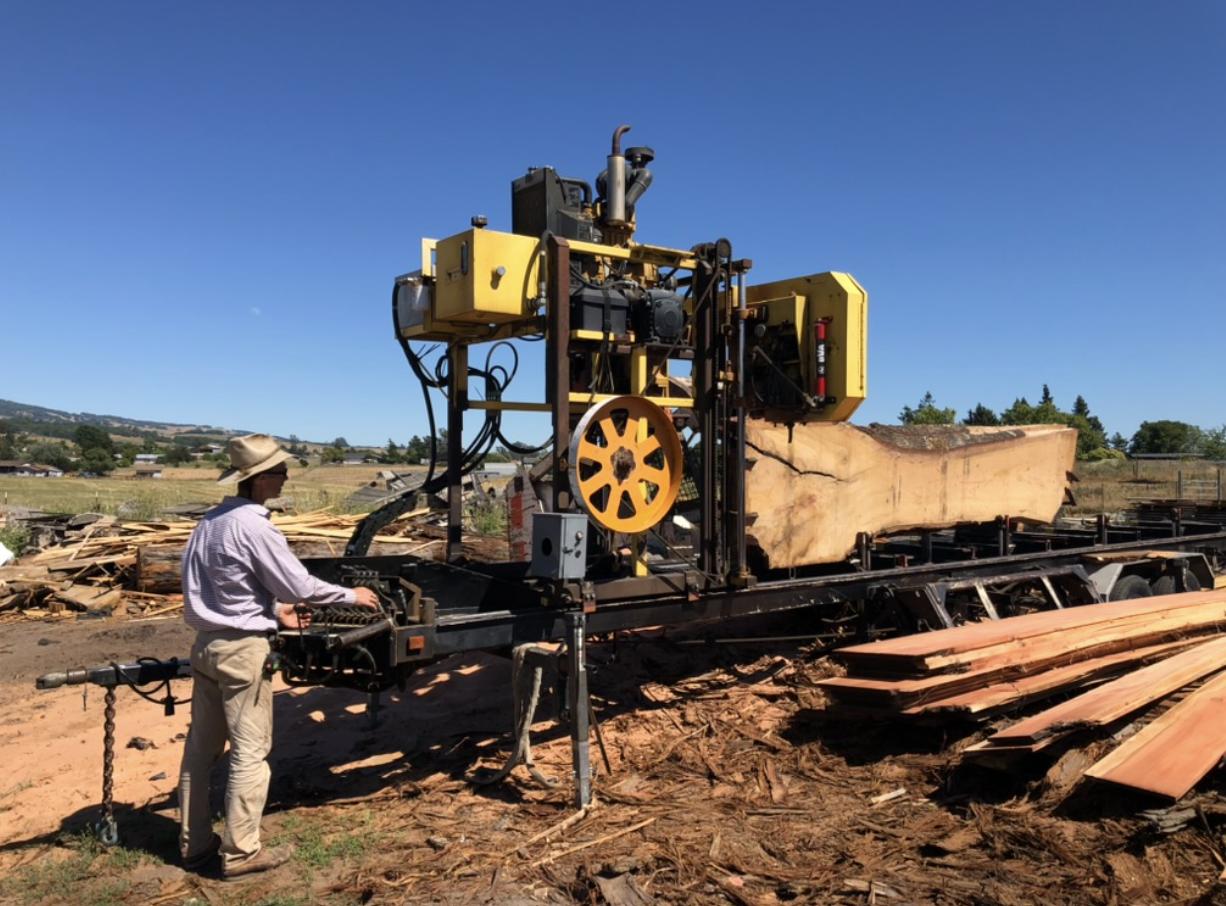
Most of the hardwood traded in this country grows east of the Mississippi and rides a truck to get here. Meanwhile, Northern California is full of magnificent trees that fall down in parks and back pastures and get treated as a disposal problem.
The cheapest thing to do with a three-foot-diameter Claro Walnut trunk is cut it into short lengths and chip it, because moving a log that heavy to a mill costs real money. So that's what usually happens. A hundred and fifty years of growth, into mulch.
We're lucky in a specific way: there's a sawmill on the same property as our shop. Shawn, our neighbor and sawyer, will send a loader and a truck for that log everyone else has written off, saw it into planks sized for the table or the cabinet run it's destined for, and — this is the part people underestimate — he knows how to dry it. Every species has its own temperament and kiln schedule. Get that wrong and you have very expensive firewood.
The embodied energy for a local slab: a short truck ride across Sonoma County, then a forklift ride across the yard. Compare that to a pallet of Pennsylvania Cherry — a truck to the sawmill, a truck to the dry kilns, a truck across the country to our distributor in San Leandro, and a truck back up to Sonoma County.
We love working in local Black Oak, Sycamore, Cypress, Claro Walnut, Douglas Fir, Redwood, and Bay Laurel — all of it grown within about an hour's drive.
The catch? Supply is limited to what’s in the pipeline at any given moment, either at Shawn’s mill or a couple of our other West Coast suppliers.
2. FSC-Certified Lumber, Veneer, and Panels
I've said we endorse the FSC. Here's the part most of the industry won't say out loud:
FSC matters far more for tropical species than for domestic hardwoods. Oak, Walnut, Maple, and Cherry coming out of Eastern U.S. forests are, for the most part, harvested under rational timber plans. Mahogany, Sapele, Teak, Ipe — that's where the stamp is doing heavy lifting, and that's where its absence should worry you.
We source FSC lumber and veneer where it counts, sometimes off the shelf and sometimes by special order. We use FSC-certified plywood and MDF on most projects. And when a client asks for a tropical species, we have a longer conversation.
3. Zero-VOC Adhesives and Lower-Toxicity Wood Finishes
What's in our shop:
Conversion varnish is the only item on that list that isn't obviously benign, so here's the honest version. The acid cure that makes it so tough releases formaldehyde as a byproduct — which is why it's restricted in some parts of Europe. In open air it's essentially done off-gassing in about 30 days. Enclosed spaces are where it lingers, which is exactly why the insides of our drawers and cabinet boxes are UV-cure prefinished Maple instead.
It is also, still, the most durable finish available for a kitchen that will be scrubbed daily for twenty years.
That's the trade, stated plainly. If it's a concern on your project, say so early and we'll talk through the alternatives — water-based conversion varnish is a good choice in some circumstances.
4. Investing In The People Who Build The Beauty
I was going to write that we treat our employees like family, and then I read it back and heard the exact greenwashed tone I've been complaining about for this entire post.
So instead: we're a small team, we pay like we intend to keep people, and the person who built your drawers has received more years of training here than they spent in high school. Ask us about it.
5. Custom Cabinetry Designed to Last for Generations
No certification, no low-VOC formula, no locally milled slab beats the arithmetic of a cabinet that doesn't get torn out. And here's the part that should bother all of us: in Houzz's 2026 kitchen study, more homeowners said they were renovating because they disliked the style of their old kitchen (41%) than because it had deteriorated or stopped working (38%). We are landfilling functional cabinets over taste and fads of style. Right now it's Rift White Oak with a slight white stain and farm sinks. In ten years we may be back to natural Cherry.
We can bring you solid joinery, hardware rated for decades, dimensions drawn to your actual body, a finish you can repair instead of replace, and — quietly the most important thing — a design that doesn't look like 2026 in the year 2036.
That's the whole environmental case for custom work, and it's the least green-sounding sentence in this post: the greenest cabinet is the one your kid decides to keep.
In summary, we don't think we've got this fully solved. Local supply is opportunistic. Certification has gaps. Every finish is a trade-off between durability and chemistry, and anyone who tells you they've found the free lunch is selling something.
But we'll show you our work: where the wood comes from, what it costs to get here, what's in the finish, and who is standing at the bench.
So, what is your next project? We’ve been building custom cabinetry since 1980, and we’re still learning every day. If you’re planning a project and care about how it is made, we’d be glad to start that conversation.
With respect,
Lewis Buchner, Owner, Estimator, and OG
MYRA Studio, Sebastpol
Here's a page from the original “Trading Sustainable Wood” brochure from February 1993—a gathering that helped lay the groundwork for what would become the Forest Stewardship Council.
License No: 1053913 (C-6 – Cabinet, Millwork & Finish Carpentry)

